
Contents of this Post
ToggleAlmost every academic conference records its sessions and almost nobody ever watches the recordings.
The reason is rarely the content. A keynote worth attending in person is worth watching afterwards and a panel discussing a developing area of a field is frequently more useful six months later than it was on the day.
The reason is that the recording is unwatchable. A camera at the back of a hall captures a speaker who occupies a small part of the frame, lit by whatever the room provides, in front of a projection screen that has become a bright rectangle with nothing legible on it. The audio picks up the room rather than the speaker. The file was then compressed by whichever platform hosted it.
What exists afterwards is a record that technically fulfils the obligation to record and serves no actual purpose.
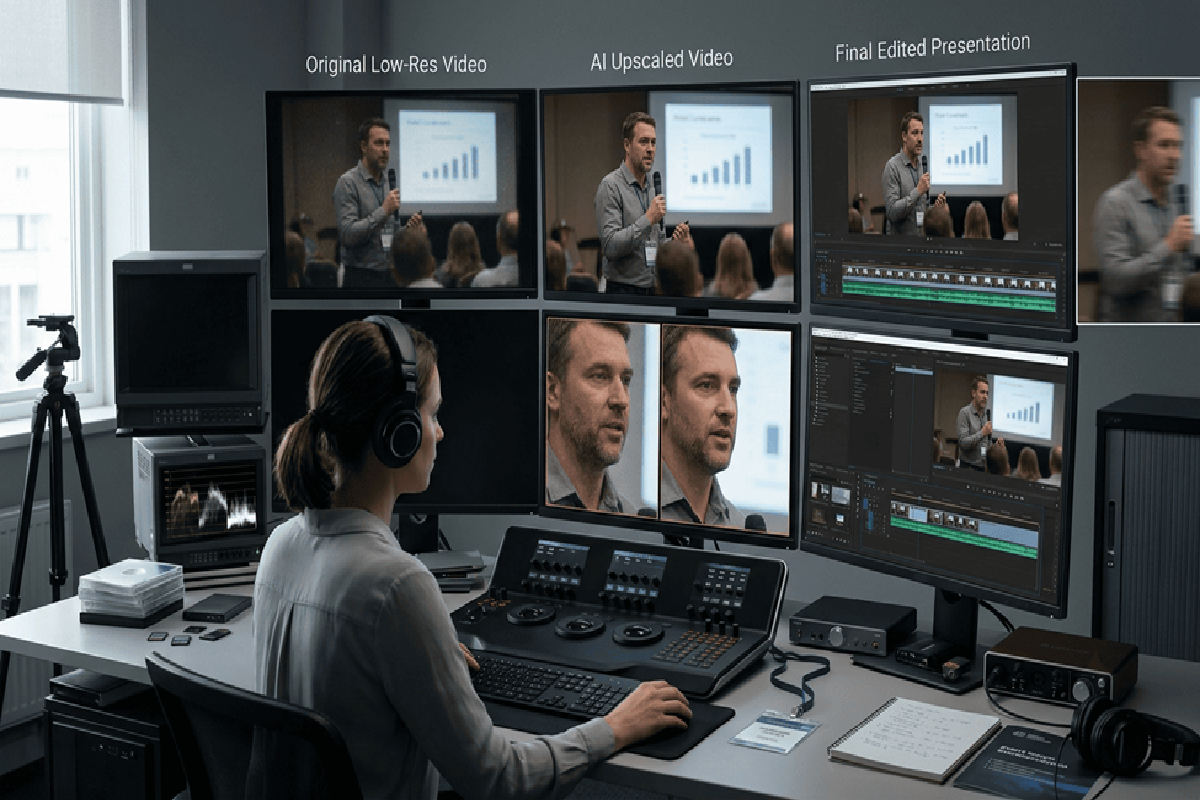
An AI Video Upscaler for practical restoration workflows through Higgsfield recovers a considerable amount of that, which matters because a talk happens once and the recording cannot be remade.
Why are conference recordings so poor?
Because the recording is nobody’s primary responsibility, and the conditions are decided by everything else in the room.
The camera position depends on where it doesn’t get in the way of the viewer, which is the back, so that’s the worst place to record a person from.
The lighting is arranged to allow the audience to see the screen, so the room is dimmed and the speaker is standing in any spill that comes to the podium.
The audio is picked up from any microphone in use and a room microphone records a room, not a voice.
When there is someone operating the machine, it is often a volunteer or student performing other tasks during the session.
None of that means that they care not at all. It’s an indication that there’s a conference going on for the people present and that the recording of the meeting is one of the duties performed during the meeting.
What does platform compression do to a session?
Rather more than most organisers realise and it compounds whatever the camera did.
Recordings hosted on video platforms are re-encoded on upload. Detail is discarded and the areas with the most detail suffer most, which in a lecture recording means the projection screen and any text on it.
Hybrid and remote sessions are worse again, because the recording is already a compressed stream before anybody saves it. A platform recording of a presentation shared over a connection has been compressed on transmission and compressed again on storage.
Long sessions compound it further, since platforms apply heavier compression to lengthy files.
And the institutional archive adds a third pass in many cases, where recordings are re-encoded for storage efficiency before being catalogued.
By the time somebody tries to watch a session from two years ago, the file has been through three or four encodings, each discarding information the previous one had already reduced.
Which recordings are worth recovering?
Not all of them and being selective makes the exercise finishable.
Keynotes and plenaries, which were selected because somebody judged them the most valuable sessions of the event.
Anything in a developing area, where the discussion dates slowly and the audience for it keeps renewing.
Methodological sessions, which get referenced long after the conference, particularly where a technique is being explained rather than a result presented.
Panel discussions, which are frequently the most useful sessions and the least documented, since nothing from them appears in the proceedings.
And anything featuring a contributor who has since become difficult to reach, retired or died, where the recording is the only record that exists.
What is not worth recovering is a session already published as a paper, a talk that was superseded by its own author and anything where the recording is captured so little that no amount of processing produces something usable.
What can an AI Video Upscaler bring back?
More than expected, because the damage is systematic rather than random.
Compression artefacts respond best of all to an AI Video Upscaler. Blocking and banding follow predictable patterns produced by known encoders and an AI Video Upscaler reconstructs them more convincingly than it handles anything unpredictable.
AI Video Upscaler resolution recovery brings a file to a standard that holds on a current display, rather than being watchable only in a small window.
AI Video Upscaler noise reduction handles the grain a camera produces in a dimmed lecture hall, which is where most of the visual degradation originated.
Motion smoothing helps where the frame rate was low or inconsistent, which is common in older room recordings and in platform captures taken over an unreliable connection.
And consistency across a set matters when a programme’s sessions were recorded by different equipment in different rooms, which is the normal situation at any conference with parallel tracks.
What about the slides in the frame?
A separate problem with a partial solution, and worth being honest about.
A projection screen recorded by a room camera is the hardest element in the frame. It is brighter than everything around it, which means the camera exposes for it badly and text on a screen photographed from twenty rows back is frequently beyond recovery.
An AI Video Upscaler improves legibility and does not create it. Where the text was captured at some level, contrast and resolution work brings it back. Where the sensor recorded nothing distinguishable, nothing can be reconstructed.
Which is why the far better answer is to obtain the slides separately. Most speakers will supply them, most conferences already collect them and a recording accompanied by the actual slide deck is considerably more useful than any amount of processing of the filmed screen.
For future events, recording the presentation feed alongside the room camera solves this entirely and costs very little.
What must never be altered?
The content of what was said and shown, which in an academic context is the whole point of the record.
Never alter audio in any way that changes meaning. Cleaning up a recording is one thing and editing what somebody said is another entirely.
Never modify slide content. A figure, a table or a citation visible in a recording is part of the record, and an improved version is no longer what was presented.
Never remove a portion of a session without indicating it. Where a recording is trimmed for length, the trim should be stated.
Never present an AI Video Upscaler version as the original. Keep the unprocessed file, note what was done and make the original available to anybody who asks.
And never alter the attribution. Who spoke, in what session, on what date, chairing what panel. These are matters of record and they appear in proceedings.
The test is straightforward. Would somebody who attended that session recognise the recording as what happened? Improving clarity passes. Anything else does not.
Who needs to agree before a recording is republished?
More parties than organisers usually check and the position differs from the one that applied at the event.
The speaker, whose consent to being recorded at a conference does not automatically extend to the recording being republished, processed or redistributed years later.
Anybody else visible or audible, which in a session with questions from the floor includes audience members who did not expect to appear in a published recording.
The copyright holders of anything shown. Slides frequently contain figures reproduced from published work under arrangements that covered a conference presentation and may not cover publication.
And the host institution, where the event took place on their premises under their own policies.
Most of this resolves with a short note to the speaker, and most speakers are pleased to have a talk made usable. The one worth checking carefully is the third, since reproduced figures are common in academic slides.
What does this mean for a department’s teaching archive?
A larger opportunity than the conference case, because the volume is considerably higher and the material is used repeatedly.
A department recording lectures across several years holds hundreds of sessions. Most were captured by the same room system, under the same conditions, which means one treatment applies across the whole collection rather than requiring individual judgment.
Those recordings serve purposes a conference archive does not. Students revisiting a difficult topic, candidates deciding whether to apply, staff covering an unfamiliar module and anybody who missed a session for a reason the institution accepts.
The recordings most worth processing are the ones already being watched. Platform analytics will show which sessions students return to and those are invariably the methodological ones rather than the introductory lectures.
An AI Video Upscaler pass across that set costs an afternoon and improves material that is being used weekly, which is a considerably better return than processing a conference archive nobody has opened.
Higgsfield keeping the treatment stored means recordings added next term match the processed back catalogue rather than becoming a visibly different generation of material.
The consent position is simpler here too, since teaching recordings are generally made under institutional policies that already cover internal reuse, though republication beyond the institution raises the same questions as any conference recording.
How does a full programme stay consistent?
By processing by source rather than by session.
Higgsfield operates as an AI creative suite, which here means the processing, the trimming and the export sit in one place rather than requiring software an organising committee would use once a year.
Grouping by camera and room works better than grouping by programme order when running an AI Video Upscaler, since recordings from the same equipment respond to the same treatment and a consistent result comes from consistent input.
A saved AI Video Upscaler treatment means sessions processed in different sittings match, which matters because this work happens in gaps across weeks rather than in one session.
Higgsfield keeping originals separate from processed versions is the discipline the previous sections depend on and a workspace that does not overwrite the source is worth more here than almost anywhere.
Higgsfield format variants from each recovered file cover the archive copy, the version for a repository and whatever a teaching platform requires.
And browser access suits a committee where the person doing this is an academic between terms rather than a technical department.
Where do recovered recordings actually get used?
Several places, and the value is higher than the effort suggests.
Institutional repositories, which increasingly accept and index recorded sessions alongside papers.
Teaching, where a recorded explanation of a method saves a lecturer preparing the same material and gives students a second account of a difficult topic.
Conference promotion for the following year, where recordings of previous sessions do more to attract submissions and attendance than any description of the programme.
Supporting published proceedings, since a paper accompanied by its presentation is a richer record than either alone.
And researcher visibility, which matters to the speakers themselves and is a reason most will cooperate readily with a request to process and publish.
What would one conference take?
A few evenings, concentrated on what is worth keeping.
Gather everything from wherever it ended up, which will include a platform account, a departmental drive and somebody’s laptop.
Select against the criteria above rather than processing the whole programme, since a smaller set done properly is more useful than everything done roughly.
Obtain the slides separately for anything where the screen matters, which is most sessions.
Group by camera and room, then process each group through an AI Video Upscaler with one treatment.
Check the consent position for each before anything is published.
Label everything with the session, the speaker, the date and the event, which takes seconds now and is nearly impossible to reconstruct later.
And store the originals alongside in Higgsfield, because the unprocessed file is the record.
Frequently Asked Questions
Can an AI Video Upscaler fix a recording made from the back of a hall?
It improves resolution, noise and compression damage considerably. It cannot change the camera position, so the speaker remains the size they were in the original frame.
Will an AI Video Upscaler make the slides readable?
Partially, where the text was captured at some level. The better answer is to obtain the slide deck separately and present it alongside the recording.
Does platform compression matter that much?
Yes, and most recordings have been through several encodings by the time anybody tries to watch them, each discarding information the previous one had reduced.
What needs checking before republishing?
Speaker consent, anybody audible from the floor, copyright on reproduced slide figures and the host institution’s policy.
Should the original be kept?
Always. The unprocessed file is the record and the processed version is a presentation of it.
Is there a way to test this on an existing archive?
Higgsfield operates a free tier, which covers processing a few sessions and comparing them against the originals before committing to a programme.
Conclusion
A conference records its sessions because recording them is expected, and the result is an archive nobody opens because the files are unwatchable rather than because the talks were poor.
An AI Video Upscaler handles the compression, the resolution and the noise that a dim hall and three rounds of encoding imposed, and Higgsfield processes a programme as a set so sessions from different rooms sit together.
What stays fixed is what was said and shown. Improve the clarity, obtain the slides separately, check who needs to agree, and keep the original file, because in a scholarly context the record is the thing that matters.