
Contents of this Post
ToggleUsed Car Buyers Guide: What the Window Form Means for Your Warranty
Walk any used car lot in the United States and you’ll see a sheet of paper taped to the side window of almost every vehicle. Most shoppers read the price, maybe the mileage, and move on. That sheet is the used car Buyers Guide, and federal rules make it part of the sales contract. The box checked on it decides who pays when the transmission starts slipping two weeks after you sign.
Plenty of buyers only learn this after something goes wrong. If that’s where you are, and the car you just bought keeps going back to the shop, Easy Lemon has a practical guide on what to do when a dealer sells you a bad car, including why an “as is” sale doesn’t always end the conversation.
If you haven’t signed yet, you’re in a better spot. The rest of this article explains what the Buyers Guide is, what each part of it means for you, and how to use it before and after the sale.
The FTC Used Car Rule Behind the Buyers Guide
The Federal Trade Commission’s Used Car Rule requires dealers to post a Buyers Guide on the used vehicles they offer for sale. The rule covers every state except Maine and Wisconsin, which run their own versions of the same disclosure. It also covers the District of Columbia and Puerto Rico. Buying online doesn’t change anything: you’re still entitled to the Guide.
Which Sellers and Vehicles It Covers
Under the rule, a “dealer” is anyone who has sold or offered for sale five or more used vehicles in the previous 12 months. That reaches far beyond the big franchise stores. Small independent lots count, and so do dealers selling cars on consignment. A private seller who sells one car a year doesn’t have to post a Guide, which is one reason private sales carry more risk.
The rule treats any vehicle driven for more than moving or test driving as used. That includes light-duty trucks and vans, demonstrators, and program cars. Motorcycles are excluded, and so are vehicles sold only for scrap or parts.
What the Guide Must Tell You
The form is short, but it does a lot of work. It tells you:
- whether the car comes with a dealer warranty or is sold “as is”
- what share of repair costs the dealer will pay if there is a warranty
- the major mechanical and electrical systems, and some of the problems to watch for
- that spoken promises are hard to enforce, so you should get them in writing
- that you can ask for an independent inspection, a vehicle history report, and a safety recall check before you buy
If the sale is conducted in Spanish, the dealer must post a Spanish-language Guide.
The Contract Clause That Gives the Guide Its Weight
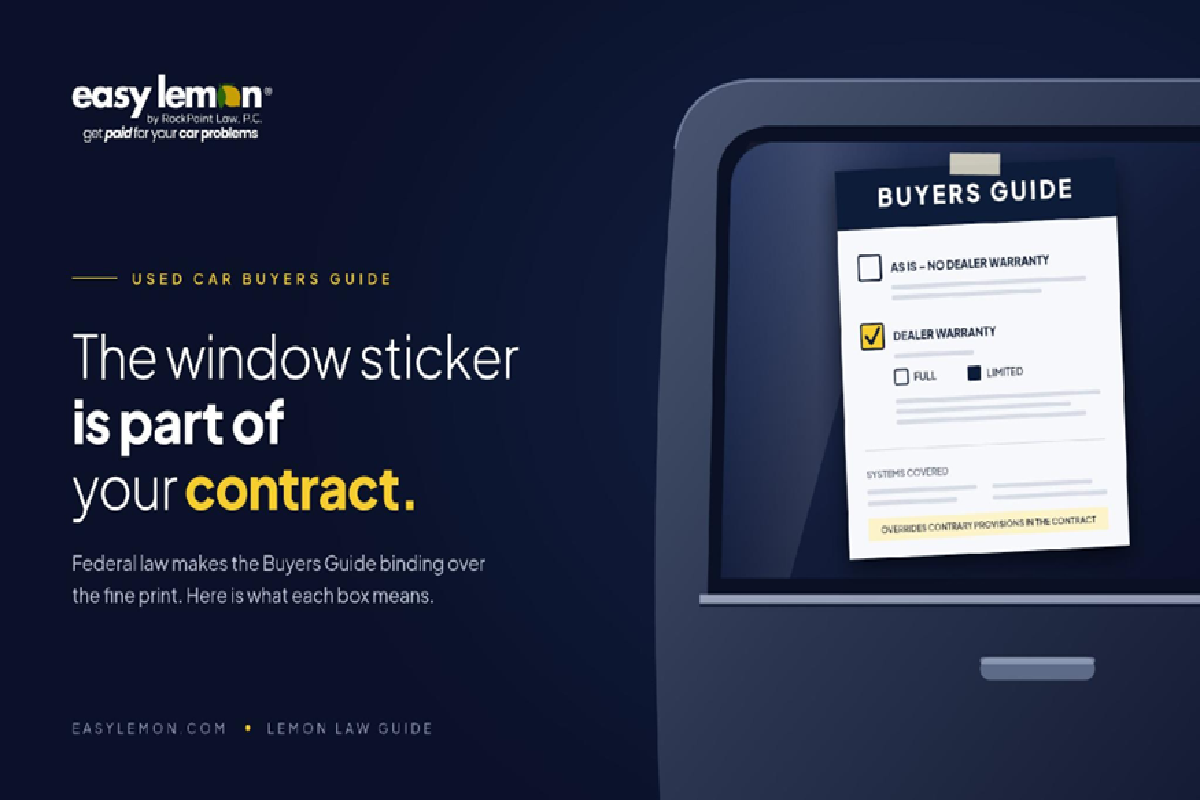
Here’s the part most buyers never hear about. Dealers have to put a specific disclosure in the sales contract. It says the information on the window form is part of the contract and “overrides any contrary provisions in the contract of sale.”
The FTC spells out what that means in practice. If the Buyers Guide says the car has a warranty and the contract says it’s sold “as is,” the dealer has to give you the warranty in the Guide. The fine print in the contract doesn’t win that fight.
That makes the Guide evidence. At signing, the dealer must give you the Guide, or a copy, showing the final warranty terms you agreed to. If the salesperson promised to fix the air conditioning or take the car back within a week, ask for that promise to be written on the Guide itself. The FTC’s own Dealer’s Guide to the Used Car Rule lays out each of these duties if you want to read the rule from the dealer’s side.
As Is, Implied or Dealer Warranty: What Each Box Means
The warranty section is where the Guide does its real work. There are three possible outcomes, and the difference between them can be worth thousands of dollars.
As Is – No Dealer Warranty
The dealer won’t pay for repairs after the sale. You take on the risk of whatever goes wrong. Where state law allows it, this one checkbox can wipe out the unwritten protections you would otherwise have. If the box is checked, any verbal promise to repair the car or cancel the sale needs to be written on the Guide, or you may have a hard time getting the dealer to follow through.
Implied Warranties Only
Some states limit or bar “as is” sales of used cars. Dealers there use this version when they don’t offer a written warranty. Implied warranties are unwritten promises that come with the sale by law, and there are two that matter most.
The warranty of merchantability means the car will do what a car is supposed to do. At minimum, it runs. It doesn’t cover every rattle or worn part, but it covers the basics.
The warranty of fitness for a particular purpose applies when you buy a vehicle based on the dealer’s advice that it suits a specific use. A dealer who steers you toward a truck for towing your trailer is implicitly promising it can do that job.
The FTC notes that implied warranty coverage can last as long as four years, though the length varies from state to state.
Dealer Warranty: Full or Limited
When the dealer offers a written warranty, the Guide has to say whether it’s full or limited and which systems it covers. Most used car warranties are limited. A full warranty has to meet a strict set of terms:
- anyone who owns the car during the warranty period can get service
- covered repairs are free, including removing and reinstalling a covered system
- if the dealer can’t fix the problem after a reasonable number of tries, you choose between a replacement and a full refund
- you only have to tell the dealer you need service
- there’s no time limit
If any one of those isn’t true, the warranty is limited. A warranty also doesn’t have to cover the whole car. It can be restricted to specific systems, such as the engine and transmission.
There’s one more protection worth knowing. Under the federal Magnuson-Moss Warranty Act, a dealer that gives you a written warranty can’t also strip away your implied warranties. A dealer can’t hand you a 30-day written warranty and then argue the car came with no other protection at all.
A Service Contract Is Not a Warranty
At some point in the sale, you’ll probably be offered an “extended warranty.” The FTC is clear that this is a service contract, not a warranty. It’s a separate product, sold by dealers, manufacturers and independent companies, at prices that vary widely.
Before you pay for one, ask a few questions. Does it duplicate coverage you already have? Is there a deductible? Do repairs have to be done at the dealer? Can you cancel it, and is there a fee? A service contract can make sense on some cars. It should never be the reason you accept an “as is” sale on a vehicle you haven’t had inspected.
Where State Law Adds More
Federal law sets the floor, and many states build on it. New York and New Jersey, for example, have used car lemon laws that require dealers to provide a limited warranty on qualifying vehicles, with coverage tied to mileage and price. Other states allow “as is” sales only if the dealer uses particular language or a separate document.
Return rights are another place where people get caught out. Federal law doesn’t give car buyers a three-day window to cancel and return the vehicle. Some states require a cancellation right, and some dealers offer one voluntarily, but you can’t count on it. Your state attorney general’s office can tell you which rules apply where you bought the car.
Five Things to Do Before You Sign
- Photograph the Buyers Guide on the lot. That fixes what was promised before negotiations start.
- Get an independent mechanical inspection. The FTC points out that a vehicle history report can show accidents or flood damage but usually won’t list mechanical problems. An inspection is still worth it on a “certified” car sold with a warranty. If a dealer won’t allow one, consider buying somewhere else.
- Ask for out-the-door pricing in writing. It helps you spot add-ons, such as gap insurance, VIN etching or rustproofing, that show up at the last minute.
- Put every promise on the Guide. Repairs, return policies and included services all count.
- Compare the final Guide with the one on the window. The copy you take home should match what you negotiated.
What to Do if the Car Fails Soon After the Sale
If a used car starts having serious problems shortly after you buy it, the order of your next steps matters.
- Find your paperwork. Pull out the Buyers Guide, the sales contract, and any written warranty or service contract. Check which box was marked on the Guide.
- Tell the dealer in writing. A phone call is easy to deny later. An email or letter that describes the problem and the date it started is not.
- Keep every repair record. Each visit should show the date, the mileage, what you reported, and what the shop did. Repeat visits for the same problem build the record a warranty claim depends on.
- Give the dealer a chance to repair it if the car is under any written or implied warranty, and follow the warranty’s instructions for getting service.
- Check whether dispute resolution comes first. Many warranties require you to try a dispute resolution program before you can sue.
- Know the federal backstop. The FTC notes that under the Magnuson-Moss Warranty Act you can sue for breach of an express warranty, an implied warranty, or a service contract, and recover reasonable attorneys’ fees and court costs if you win. Smaller disputes can also go to small claims court.
Conclusion
The Buyers Guide looks like a formality, but it’s one of the few documents in a used car sale that federal law treats as binding over the fine print. Read it before you negotiate, photograph it, get every promise written onto it, and keep the final copy with your contract. If the car turns out to be a problem, that sheet of paper is often the first thing a lawyer, a court, or the dealer will ask to see.