
Contents of this Post
ToggleProxy servers for AI voice agents: six providers ranked on protocol, latency and price
ITU-T G.114 treats one-way delay of up to 150 ms as acceptable for most voice applications and anything past 400 ms as unacceptable for general network planning. A voice agent already spends most of that budget on speech recognition, model inference and synthesis. Whatever network hop you add has to fit in what is left.
That is the constraint behind choosing proxy servers for AI voice agents. A badly placed proxy makes the bot sound slow, or it drops the one WebSocket the whole call depends on.
This ranking compares six providers on the properties a voice workload exercises: static dedicated addresses, TCP tunnelling for long-lived WebSockets, throughput per IP, billing model and the smallest order you can place. Prices were read from each provider’s public pages in October 2026.
Why AI voice agents need a proxy layer
Most voice agents run on autoscaled cloud instances, so their outbound address changes with every deploy or scale-out event. That is fine until the agent calls something that checks the source IP: a CRM behind a corporate firewall, a booking system with an allowlist, a self-hosted model endpoint.
A dedicated static proxy gives every outbound connection one fixed address that a security team can allowlist. Healthcare and finance integrations often require it.
Hosted platforms leave the same gap. Vapi’s SIP networking documentation lists two static signalling addresses per region and states that RTP media does not use static IPs.
Other reasons come up in practice. Multi-tenant platforms assign one egress IP per customer, so one tenant’s rate limit does not affect the rest. QA teams place synthetic callers in the countries their users call from to measure regional latency. And some enterprise networks do not permit outbound traffic that skips an approved proxy.
One limit to keep in mind. A rented forward proxy fixes the source address of connections your code opens. It does nothing for connections a platform opens toward you, such as webhooks, which need an ingress with a fixed address.
What a proxy can and cannot carry in a voice stack
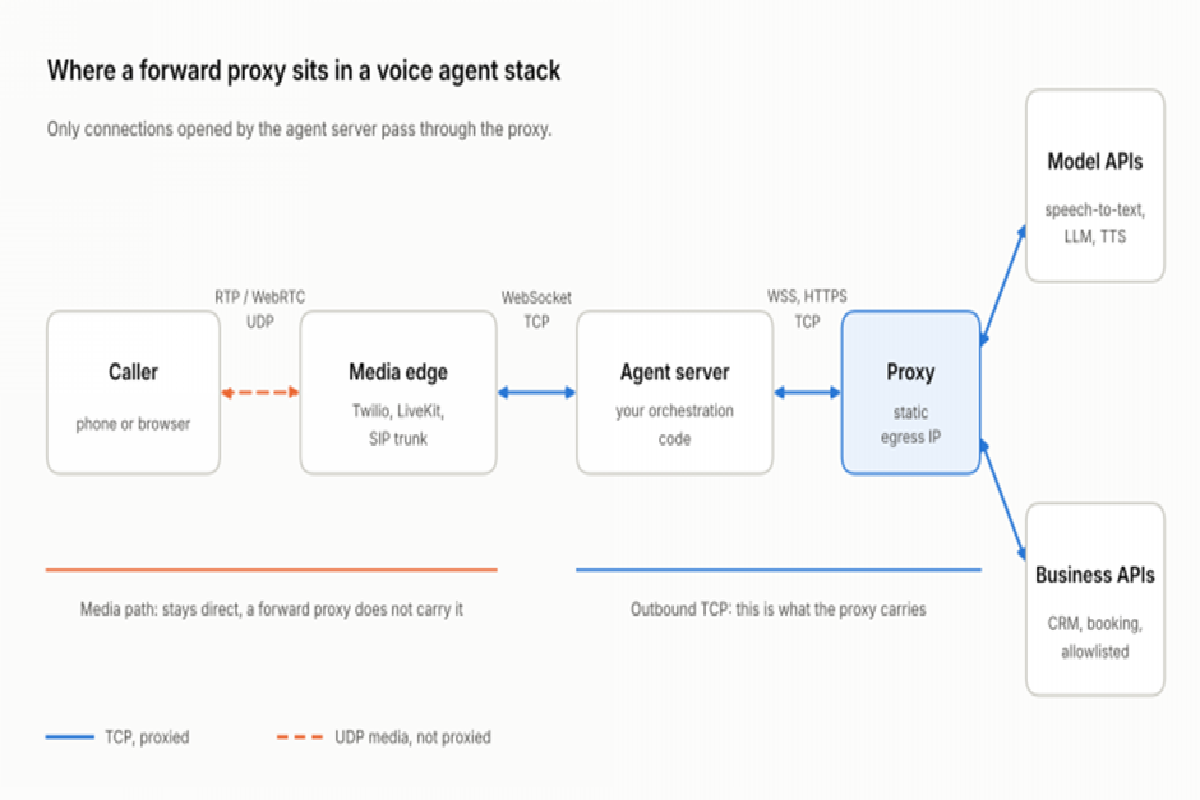
An HTTP proxy tunnels TCP through the CONNECT method. A SOCKS5 proxy relays TCP and, where the server implements UDP ASSOCIATE from RFC 1928, UDP datagrams as well. Voice stacks use both transports for different jobs.
Figure 1. A forward proxy carries the TCP connections the agent server opens. Call media stays on its own path.
TCP traffic: WebSockets, REST and tool calls
Speech-to-speech and streaming model APIs run over secure WebSockets. OpenAI’s WebSocket audio guide has the server exchange base64-encoded audio inside JSON events, with PCM16 at 24 kHz as the default format and G.711 at 8 kHz as the telephony option. All of it passes through a CONNECT tunnel or a SOCKS5 TCP relay unchanged.
Twilio Media Streams works the other way round. Twilio opens the WebSocket to your server and sends μ-law audio at 8,000 Hz, base64-encoded, so no forward proxy sits on that leg. The proxy appears on the next one, where your server connects out to the model.
UDP traffic: RTP and WebRTC media
Call media is different. RTP and WebRTC audio travel over UDP, and an HTTP proxy cannot carry UDP at all. LiveKit’s firewall reference shows the usual fallback chain: ICE over UDP on ports 50000 to 60000, ICE over TCP on 7881 when UDP is blocked, then TURN over TLS.
SOCKS5 UDP support on the provider side helps only if your media library can speak UDP ASSOCIATE, and most SIP and WebRTC stacks cannot. Plan on keeping media direct or on TURN, and put the proxy on signalling, model and API traffic.
The table maps each traffic class to the proxy type that can carry it.
| Traffic | Transport | HTTP(S) proxy | SOCKS5 proxy | Bitrate per direction |
| Tool calls, CRM lookups, outbound webhooks | HTTPS over TCP | Yes | Yes | Bursty, a few kB per call |
| Model WebSocket, G.711 μ-law at 8 kHz | WSS over TCP | Yes, via CONNECT | Yes | About 85 kbps of payload |
| Model WebSocket, PCM16 at 24 kHz | WSS over TCP | Yes, via CONNECT | Yes | About 512 kbps of payload |
| SIP signalling | UDP or TCP 5060, TLS 5061 | No | Only if the SIP stack supports SOCKS | Negligible |
| RTP or WebRTC media | UDP | No | Only with UDP ASSOCIATE at both ends | 64 kbps for G.711 before headers |
Where a VPS fits next to the proxy
Two jobs in a voice stack need a machine with its own public address rather than a rented proxy. The first is ingress. Twilio Media Streams and platform webhooks connect to you, so they need an endpoint that stays put when the agent fleet scales. A small VPS running Nginx or Caddy as a reverse proxy in the backend’s region gives them that endpoint and forwards traffic to the autoscaled servers. The second is TURN. If you self-host LiveKit or another WebRTC stack, the TURN relay needs a public static IP and open UDP ports, which no forward proxy provides. LikeVPS, a VPS service from the team behind proxys.io, covers both: every plan includes a dedicated IPv4, unmetered traffic and DDoS filtering, in cities that host major cloud regions, among them Frankfurt, London, Singapore and Tokyo. Plans start at $10 a month in continental Europe and $23 in London, New York and Singapore, with a 14-day refund window.
Best proxy servers for AI voice agents at a glance
All six sell static dedicated addresses with HTTP(S) and SOCKS5 endpoints. They differ in how small an order they accept, how traffic is capped and how much account administration they add.
| Rank | Provider and product | Entry price | Smallest published order | Protocols | Limit that matters for voice |
| 1 | Proxys.io, individual IPv4 | $2.30 per IP for 1 to 4, $1.60 from 5, from $1.47 at volume | 1 IP | HTTP, HTTPS, SOCKS5 | 7 Mbit channel per proxy, 10 Mbit on request |
| 2 | IPRoyal, dedicated datacenter | From $1.57 per proxy for 30 days, $1.39 on 90-day terms | Not stated on the pricing page | HTTP(S), SOCKS5, TCP and UDP | 100 GB per proxy per month, then throttled |
| 3 | Oxylabs, dedicated datacenter | $2.25 per IP | 3 IPs, $6.75 a month | HTTP, HTTPS, SOCKS5 with TCP and UDP | Three-IP minimum order |
| 4 | Decodo, dedicated ISP | $3.33 per IP at 3 IPs, $2.90 at 10 | 3 IPs, $9.99 a month | HTTP(S), SOCKS5 | 19 countries for dedicated ISP |
| 5 | Bright Data, shared ISP | $1.80 per IP at 10 IPs, $3.50 dedicated | 10 IPs, $18 a month | HTTP(S), SOCKS5 through Proxy Manager | 100 GB fair-use allowance per IP per month |
| 6 | Webshare, dedicated datacenter | $1.33 per proxy at 20 proxies | 20 proxies, $26.60 a month | HTTP, SOCKS5 | 250 GB on the base plan, 500 to 3,000 threads |
Per-GB networks are missing on purpose. The arithmetic is in the bandwidth section below.
The providers in detail
Proxys.io
Proxys.io takes first place because it publishes a one-IP price tier and bills flat per address instead of per gigabyte. A single individual IPv4 address costs $2.30 a month, $1.60 from five addresses and from $1.47 at volume, with 5% off six-month terms and 12% off twelve-month terms.
Each proxy ships with HTTP(S) and SOCKS5 ports, a login and password, and optional IP authorization from the account panel. Addresses are issued automatically after payment. The static IPv4 price list covered 24 countries plus Russia when checked, among them the US, UK, Germany, the Netherlands, India, Brazil and Australia.
The trade-off is throughput. The provider states a 7 Mbit channel on static proxies, raised to 10 Mbit on request. That is ample for signalling, tool calls and narrowband relay, and tight for more than a handful of wideband PCM sessions per address. The refund window is 24 hours, and new customers can ask support for a test proxy.
IPRoyal
IPRoyal ranks second and is the pick when one address has to carry heavy traffic. Its dedicated datacenter proxies start at $1.57 for 30 days and $1.39 on 90-day terms, with HTTP(S) and SOCKS5, TCP and UDP, and 60+ locations. The provider quotes roughly 1 Gbps in each direction. Each proxy includes 100 GB a month, pooled across the order, after which speed is reduced.
Oxylabs
Oxylabs documents SOCKS5 with both TCP and UDP on its dedicated datacenter product, which matters if your media library can use UDP ASSOCIATE. Pricing is $2.25 per IP with a three-IP minimum, so the smallest bill is $6.75 a month. It makes most sense for teams that already buy from Oxylabs and want one vendor.
Decodo
Decodo’s dedicated ISP proxies give you an ISP-registered address hosted in a data centre. Three IPs cost $9.99 a month and ten cost $29. Dedicated ISP locations span 19 countries, and the 14-day money-back option is longer than the 24 hours at Proxys.io or the two days at Webshare.
Bright Data
Bright Data advertises 99.99% network uptime and sells shared ISP addresses from $1.80 each in a ten-IP plan, or $3.50 each dedicated. Every IP carries a 100 GB monthly fair-use allowance. SOCKS5 runs through its Proxy Manager, and billing works on monthly account commitments, which is a lot of administration for a two-address deployment.
Webshare
Webshare gets cheap at volume ($0.98 per proxy at 2,000) and is the most expensive to start. Dedicated datacenter proxies cost $1.33 each, but the smallest plan is 20 proxies for $26.60 a month. HTTP and SOCKS5 endpoints, 50+ countries and a stated 99.97% uptime are included. The free tier of 10 shared proxies is handy for wiring up a prototype.
What to look for in a proxy for voice workloads
Five properties decide whether a proxy helps a call or hurts it.
- A dedicated static address. Shared or rotating IPs break allowlists and reset long-lived WebSockets when the exit changes.
- An exit in the same region as the model endpoint. QuotaGuard, which sells static egress for cloud apps, reports under 20 ms added for a same-region hop on its own network. A transatlantic detour adds roughly 70 ms or more of round trip.
- Flat per-IP billing, because audio is continuous traffic.
- Both HTTP CONNECT and SOCKS5 endpoints, so each client library can use whichever it supports.
- IP authorization as well as credentials. Some WebSocket clients handle proxy authentication poorly, and authorizing the server’s address on the proxy avoids the problem.
How to connect a proxy to a voice agent
The whole change lives on the agent server.
- Buy one static address in the cloud region where the agent runs and note its HTTP and SOCKS5 ports.
- Add the agent server’s public IP to the proxy’s authorization list, or keep the login and password in a secret store.
- Point only the outbound model and API clients at the proxy. In Python’s websockets library, set wss_proxy or https_proxy, for example socks5h://user:pass@host:port, and install python-socks for SOCKS. In Node, pass an https-proxy-agent instance to ws.
- Leave RTP and WebRTC media off the proxy, and list any hosts that must stay direct in no_proxy.
- Give the destination’s security team the proxy address for their allowlist, then confirm the source IP they see in their logs.
Use socks5h instead of socks5 when the proxy should resolve DNS. Otherwise the lookup happens on the agent host, and a geo-aware API may return an endpoint far from the proxy’s exit.
Common proxy failures in voice pipelines and how to fix them
A 407 Proxy Authentication Required on the CONNECT request means the client never sent credentials. This is common with WebSocket libraries that ignore the userinfo part of a proxy URL. Switching to IP authorization is the fastest fix.
Sessions that die after a fixed quiet period point to an idle timeout on the proxy or a middlebox. Send WebSocket pings every 15 to 20 seconds.
Choppy or delayed agent speech usually comes from TCP itself. One lost packet stalls everything behind it until the retransmission arrives, and a distant proxy lengthens that stall. Move the exit closer to the model endpoint before changing anything else.
Audio that degrades only at peak hours is a throughput ceiling. Count concurrent sessions per address and compare the total with the provider’s per-IP limit.
Sizing bandwidth and cost per call
Figure 2. Base64 framing adds one third to every audio format a voice agent relays over a WebSocket.
PCM16 at 24 kHz is 384 kbps of raw audio. Base64 inside JSON raises that to about 512 kbps per direction, and G.711 comes out near 85 kbps. Message envelopes add a little more.
On a 7 Mbit channel that works out to roughly six concurrent wideband sessions with both directions active, or 30 or more G.711 sessions. Spread larger loads across several addresses, or pick a provider with a higher per-IP ceiling.
The same numbers explain why proxy servers for AI voice agents are better bought per IP than per gigabyte. An hour of two-way 24 kHz PCM is about 460 MB if both directions stream continuously. SOAX’s Sandbox rate for tier 1 countries is $5.00 per GB, so that call hour costs about $2.30 in proxy traffic alone. A static address costs the same amount for a month.
When to switch proxy provider
Three signals justify a move: a per-IP ceiling you hit every week, a minimum order or monthly commitment that costs more than the addresses you use, and support that takes hours while calls are failing.
Proxys.io commits to a first response in chat within five minutes and says replies usually arrive in 10 to 15 seconds. For a team running two to ten static addresses, that and the one-IP pricing matter more than pool size. Teams pushing hundreds of megabits through each address are better served by IPRoyal’s larger channel.
Frequently asked questions
Do AI voice agents need residential proxies?
Rarely. Model APIs, CRMs and telephony platforms identify clients by API key and allowlist, so a dedicated datacenter or ISP address is the right tool. Residential pools rotate, bill per gigabyte and add latency, and all three hurt a call.
Can a SOCKS5 proxy carry RTP or WebRTC audio?
Only when the provider relays UDP and your media stack implements UDP ASSOCIATE. Proxys.io describes TCP and UDP handling on its SOCKS5 proxy page. Confirm it for your tariff with support before designing around it, and keep TURN over TLS as the fallback.
What do proxy servers for AI voice agents cost?
Static dedicated addresses in this comparison start between $1.33 and $3.50 per IP per month. The real difference is the minimum order, from one address at Proxys.io to 20 at Webshare.
Picking a provider for a first deployment
For a first production deployment of proxy servers for AI voice agents, start with one static address in the agent’s cloud region, IP authorization on, and only model and API clients routed through it. Proxys.io fits that pattern at $2.30 a month. Move to IPRoyal or Oxylabs when a single address has to carry more than about six wideband sessions.
Then measure. If time to first audio byte rises by more than 20 ms with the proxy in the path, the exit is in the wrong region.