
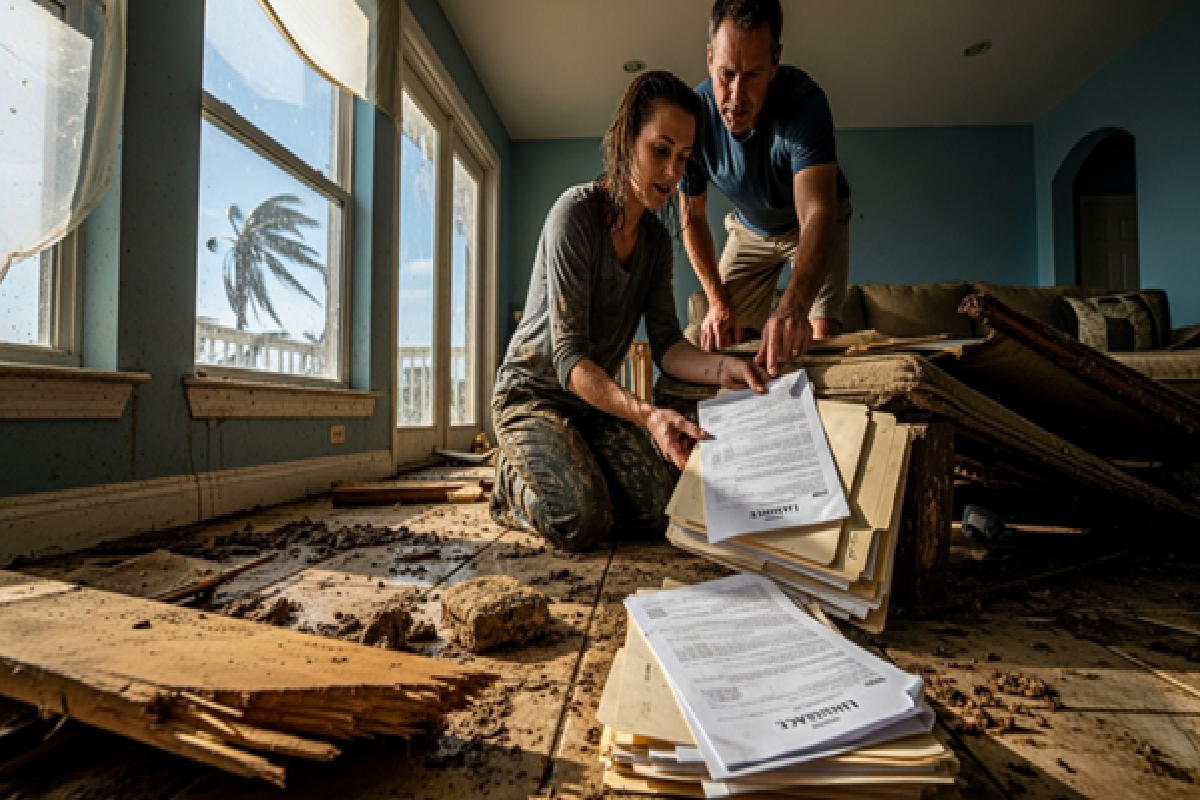
Hurricanes represent a significant and recurring financial risk to property owners across Florida. The immense vulnerability of the state’s homeowners is starkly illustrated by the fact that Broward County, home to Fort Lauderdale, faces the second-highest expected annual financial loss from hurricanes in the United States at nearly $900 million. This high-stakes environment is further complicated by a fundamental misunderstanding of insurance policies, which contributes directly to the financial instability many residents face after a catastrophic storm. A clear analysis of the legal and contractual differences between standard homeowners’ policies and separate flood insurance is therefore essential for mitigating these risks.
This article provides a scholarly analysis of the complex insurance landscape in Florida, dissecting the critical distinction between wind and flood damage. It will proceed by first examining the explicit flood exclusion found in typical homeowners’ policies, a contractual detail that is often the source of post-storm disputes. Second, it will detail the available flood insurance options through federal and private programs, which are designed to fill this coverage gap. Finally, the analysis will explore the legal challenges inherent in disputed hurricane claims, offering clarity for policyholders seeking to protect their assets.
- What is the Scope of Coverage for Wind vs. Water Damage Under Florida Law?
The Peril of Water: Why Standard Policies Exclude Flooding
Standard homeowners’ insurance policies in Florida, such as the common HO-3 form, are typically all-risk policies that cover damage from any cause unless it is explicitly excluded. Almost universally, these policies contain an unambiguous exclusion for damage caused by flooding. The standard policy language defines a flood as surface water, waves, tidal water, overflow of a body of water, or spray from any of these, whether or not driven by wind. This definition is legally distinct from other forms of water damage that are generally covered, such as water from a burst pipe or wind-driven rain entering a home through a storm-damaged roof. This contractual distinction is the foundational reason for a majority of claim disputes following a hurricane.
A Critical and Costly Misconception
A widespread and costly misconception exists among many Florida residents who incorrectly believe their standard homeowners’ policy provides comprehensive coverage for all hurricane-related damage. The financial consequences of this misunderstanding are severe. Data from recent storm seasons reveal a significant gap between policyholder expectations and policy realities. Following recent hurricanes, Florida insurers closed 46.7% of home insurance claims without any payment. Furthermore, overall statistics show that only about half of all residential claims filed resulted in any payment to the homeowner. This data underscores the critical importance of understanding that wind damage and flood damage are treated as separate perils requiring distinct insurance products.
- How Can Homeowners Navigate Florida’s Evolving Flood Insurance Landscape?
The National Flood Insurance Program (NFIP) as a Safety Net
The National Flood Insurance Program (NFIP) is a federal program administered by the Federal Emergency Management Agency (FEMA) that was created to provide a financial safety net by offering flood insurance to properties in participating communities. For decades, it has served as the primary source of flood coverage for most Americans. The program’s importance is highlighted during major catastrophic events; for instance, Hurricane Ian in 2022 became one of the largest flood disasters in the NFIP’s history based on total payouts. This underscores its essential role in the financial recovery of communities devastated by widespread flooding.
Economic Pressures: Risk Rating 2.0 and Its Impact on Premiums
In an effort to modernize its pricing structure and address its multi-billion-dollar debt, FEMA recently implemented a comprehensive overhaul known as Risk Rating 2.0. The program’s objective is to align insurance premiums more accurately with a property’s actual flood risk, moving away from a system that subsidized many high-risk properties. While this change has caused hundreds of thousands of Americans, particularly those in lower-income households, to drop their coverage nationwide due to rising costs, Florida has notably defied this trend. Despite the premium increases, the state has added nearly 100,000 NFIP policies since 2021, demonstrating a heightened awareness of flood risk among its residents.
Comparison of Flood Insurance Options
As the NFIP undergoes significant changes, the private flood insurance market has emerged as a viable and increasingly popular alternative. Private policies often provide more flexible and comprehensive coverage options compared to the standardized federal program. For property owners, understanding the differences between these two avenues is crucial for making an informed decision that best protects their assets. A direct comparison reveals key distinctions in coverage limits, covered expenses, and policy terms.
| Feature | National Flood Insurance Program (NFIP) | Private Flood Insurance |
| Coverage Limits | Capped at $250,000 for building and $100,000 for contents (residential). | Often offer higher, more flexible limits, which can exceed NFIP caps. |
| Additional Living Expenses | Not typically covered; homeowners must pay for temporary housing out-of-pocket. | Often included, covering hotel stays and other displacement costs. |
| Replacement Cost | Often limited to Actual Cash Value (depreciated value) for contents. | More likely to offer full Replacement Cost Value for both building and contents. |
| Waiting Period | Typically a 30-day waiting period before the policy takes effect. | Can have much shorter waiting periods, sometimes as little as 10-14 days. |
| Policy Customization | Standardized federal policy with limited ability to customize. | Policies can be tailored with various endorsements and coverage options. |
2026 Legislative Horizon: Bridging the Public-Private Gap
Recognizing the need for a more competitive and consumer-friendly flood insurance market, bipartisan efforts are underway in Congress. Florida representatives have led the push for legislation designed to better integrate the NFIP with the growing private market. A key piece of proposed legislation is the Continuous Coverage for Flood Insurance Act. This bill would permit policyholders to switch to a qualifying private flood policy without losing their eligibility for grandfathered NFIP rates if they decide to return to the federal program later. This is a crucial development, as it would remove a significant financial disincentive for homeowners who wish to explore potentially better rates or coverage in the private market.
III. What Happens on the Legal Battleground of Wind vs. Flood in Disputed Hurricane Claims?
The Doctrine of Concurrent Causation and Its Implications
A central legal issue in hurricane claim litigation in Florida is the doctrine of concurrent causation. This principle applies when property damage results from a combination of a covered event, such as wind, and an excluded event, such as a flood. For example, a hurricane’s winds may first destroy a roof, allowing rain to enter and cause significant interior damage (a covered loss), before a storm surge floods the property (an excluded loss). Florida courts must analyze these complex scenarios to apportion damages between the covered and excluded causes, a process that is highly fact-intensive and often requires extensive analysis from engineers and meteorological experts to determine the sequence and magnitude of each peril’s impact.
Common Insurer Tactics in Denying and Underpaying Claims
In the aftermath of a major hurricane, insurance carriers may employ various strategies to limit their financial exposure and minimize payouts. Policyholders should be aware of these common tactics, which can create significant obstacles to a fair and timely recovery. These strategies often exploit the ambiguity between wind and water damage to shift the financial burden back onto the insured.
- Damage Misattribution: An insurer might unilaterally attribute the majority of damage to storm surge or flooding, thereby invoking the policy’s flood exclusion. This often occurs even when substantial evidence indicates that wind-related damage, such as a compromised roof, happened first and was the primary cause of the subsequent interior water intrusion.
- Biased Engineering Reports: Some carriers may commission reports from engineering firms known to produce findings that favor the insurer’s position. These reports may conclude that flooding was the sole or primary cause of loss, often overlooking or downplaying evidence of significant structural damage from wind forces.
- Unreasonable Delays: By stalling the claims process, insurers can exert financial pressure on policyholders who are often in a desperate situation. These delays can push financially strained homeowners into accepting a low settlement offer out of necessity rather than fairness.
- Lowball Settlement Offers: Insurers may present initial settlement offers that are far below the actual cost of repairs and rebuilding. Such offers frequently fail to account for the current costs of labor and materials, which often escalate in a post-disaster environment.
The Necessity of Expert Legal Counsel for Policyholders
Challenging a denied or underpaid hurricane claim is a formidable task for a homeowner to undertake alone. This is especially true in Florida, which is the epicenter of homeowners’ insurance litigation, accounting for an astonishing 79% of all such lawsuits in the United States. Navigating these complex disputes requires a deep understanding of insurance policy language, engineering principles, and hurricane-related laws in Fort Lauderdale and across the state. Policyholders often need legal representation to level the playing field. For those facing such challenges, seeking a consultation with an experienced firm that understands hurricane laws in Fort Lauderdale can be a critical step toward a fair recovery.
Florida’s New Legal Landscape: The Urgency to Act
The legal environment for insurance claims in Florida has recently undergone significant changes. Legislative reforms, such as HB 837 passed in 2023, have directly impacted policyholders’ rights. One of the most critical changes was shortening the statute of limitations for filing general negligence claims from four years to two years. This reform creates a much greater sense of urgency for property owners. It is now more important than ever for homeowners to assess their damage thoroughly and seek qualified legal advice promptly after a storm to ensure they do not forfeit their right to pursue a claim.
Fortifying Financial Defenses Against Florida’s Inevitable Storms
This analysis has demonstrated that standard homeowners’ insurance is fundamentally insufficient for complete hurricane protection in Florida due to the explicit and universally applied flood exclusion. To secure one’s assets, obtaining separate flood coverage through either the NFIP or the private market is a non-negotiable component of responsible property ownership. The claims process itself is fraught with legal and factual complexities, particularly surrounding the distinction between wind and water damage, which often necessitates professional legal intervention to ensure a fair outcome for the policyholder.
For Florida property owners, true preparedness extends beyond physical preparations like storm shutters and evacuation plans. It must include a fortified financial defense built on a clear and accurate understanding of insurance coverage. Proactive policy review, securing adequate flood insurance, and knowing one’s legal rights are the most effective measures to prevent financial devastation long after the storm clouds have cleared. This diligence is the ultimate protection against the inevitable storms on Florida’s horizon.