
Contents of this Post
ToggleWhy Preparation Matters for Your First Meeting
Arriving prepared empowers your immigration attorney and immigration lawyer to deliver precise legal advice and efficient client assistance from day one. The right evidence lets a law firm conduct an informed case evaluation of your immigration case, spot risks, and chart a realistic path through immigration law, immigration policy, and federal agencies procedures. Whether you’re seeking a visa, permanent residency, or US citizenship, complete documentation helps your legal representation avoid delays and adverse findings.
Experienced practitioners often follow guidance from professional bodies like AILA (American Immigration Lawyers Association), whose practice updates and immigration news align strategy with evolving policy briefs. For a primer on how attorneys assess eligibility, waivers, and timelines across family immigration, employment immigration, refugee and asylum matters, see this immigration law guide. You can also review general expectations at an immigration attorney resource to understand how documents drive a strong first consultation.
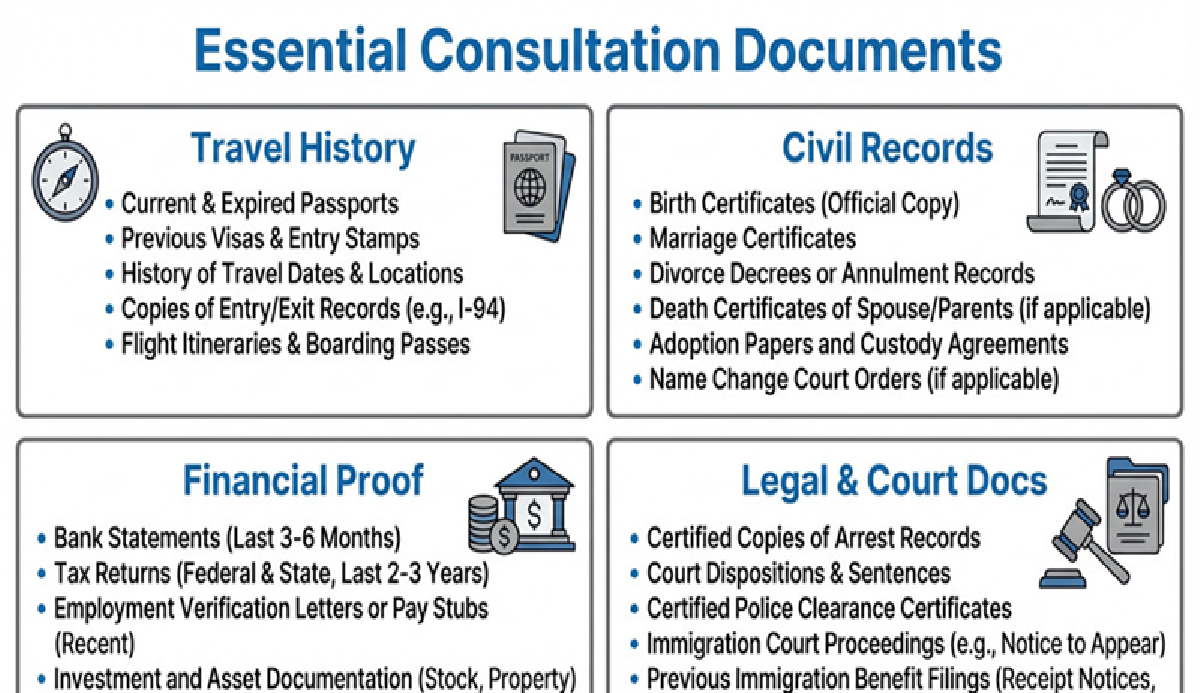
The 25 Things to Bring
Travel and Status History Documents
1) All current and expired passports (from every country you’ve held citizenship in)
Your immigration lawyer will use these to reconstruct travel history, prior visas, and admissions—crucial for maintaining lawful presence, naturalization planning, and US citizenship eligibility analysis.
2) Your I-94 record and travel/entry documents (visas, entry stamps, boarding passes)
Entry records determine whether you were admitted, paroled, or entered without inspection, central to immigration process strategy and potential removal defense. If you need help locating representation to review complex histories, see the USCIS find legal services page.
3) USCIS/DHS/DOS notices and receipts (I-797s, RFEs, NOIDs, approval/denial letters)
These drive immediate case evaluation—deadlines, status, and eligibility under immigration law. They also inform appeals strategy if prior benefits were denied.
4) Copies of any prior immigration applications and full supporting packets you submitted
Your immigration attorney will verify what was claimed, what evidence was used, and how to correct or supplement the record to advance a green card, visa, or citizenship application.
5) Removal or court materials (NTA, EOIR hearing notices, judge decisions, bond documents)
For anyone facing deportation or in proceedings, these define the relief available and timing. They also inform whether motions, appeals, or other removal defense steps are viable.
Evidence for Benefits and Eligibility
6) Criminal records—certified court dispositions, police reports, and fingerprint/FBI results
Immigration policy treats arrests and convictions differently than criminal law. Your law firm must analyze admissibility, good moral character (for naturalization or US citizenship), and eligibility for waivers.
7) Civil status records (marriage certificates, divorce decrees, death certificates, name changes)
These establish qualifying family relationships and prevent inconsistencies that can trigger RFEs or NOIDs in family immigration filings.
8) Birth certificates for you and qualifying relatives (with certified translations as needed)
Identity and relationship proof are fundamental for benefits under immigration law—especially for derivative or immediate-relative pathways.
9) Evidence of lawful status history (I-20s/DS-2019s, SEVIS, parole, EADs, reentry/advance parole)
Maintaining or falling out of status can determine adjustment eligibility, bars, or need for consular processing.
10) Employment evidence (job offer letters, pay stubs, W-2s/1099s, employer verification letters)
Core to employment immigration. Counsel may cross-reference PERM issues, DOL policies, or potential challenges that could lead to Board of Alien Labor Certification Appeals (BALCA) review if a labor certification is involved.
11) Recent tax returns and IRS transcripts (typically the last three years)
Tax records help verify maintenance of status, income for sponsorship, and continuous residence—often relevant to both green card paths and later naturalization.
12) Financial sponsorship evidence (draft I-864/I-134, sponsor’s tax returns, pay stubs, domicile proof)
Your immigration lawyer will check poverty guidelines, household size, and joint sponsor options to avoid affidavits that fail at review.
13) Education and professional credentials (diplomas, transcripts, licenses, credential evaluations)
For H-1B or other specialist visas, accurate credential evaluations align your background with regulatory criteria and anticipated scrutiny by federal agencies.
14) Proof of residence and physical presence (leases, utility bills, bank/mail records, travel logs)
Essential for continuous residence and physical presence tests for US citizenship, as well as bona fides in marriage-based adjustment.
15) Evidence of a bona fide relationship for family cases (photos, messages, joint accounts/insurance)
Quality over quantity—chronological, consistent, and jointly held records strengthen credibility.
16) Medical and vaccination records (I-693 sealed if already obtained, prior exam or vaccine summaries)
The civil surgeon’s I-693 can be filed later, but bringing any prior health records streamlines planning.
17) A list of all names/aliases used, dates of birth, A-Numbers, and prior case numbers
This helps your legal representation reconcile databases across USCIS, DOS, and CBP systems and avoid identity mismatches.
18) A detailed timeline of immigration history and all international travel dates
Your immigration attorney will spot gaps, unlawful presence risks, or eligibility windows for benefits like adjustment of status or waivers.
19) Contact details for sponsors, employers, or witnesses and any draft affidavits
Early outreach enables timely, well-corroborated filings.
20) Certified translations for all non-English documents
Translations must meet regulatory standards to be accepted.
Translation and Copies Checklist
21) Both originals and clear copies, organized in labeled folders or a digital drive
Organized packets accelerate client assistance, reduce attorney review time, and promote professionalism in legal practice.
22) Your questions, goals, and any specific concerns or priorities for the case
Clarity helps your immigration lawyer tailor strategy—whether the priority is speed, travel flexibility, or future US citizenship.
23) A payment method for the consultation and a notebook to take notes
A smooth intake allows the law firm to focus on substance, timelines, and risk management.
24) An interpreter or accessibility support person if you need language or other assistance
Professional interpreters reduce misunderstandings and support judicial conduct standards during proceedings.
25) Online account access and case numbers (USCIS, CEAC/DS-260, SEVIS, and tracking portals)
Real-time access lets your immigration attorney confirm filings, notices, and biometrics quickly, including uscis portal updates.
How to Organize and Communicate
- Label by topic: identity, entries, status, work, family, court, medical, financial.
- Create a master index and a one-page executive summary for your immigration case.
- Flag urgent deadlines in bold.
- Share questions in advance so the immigration lawyer can prepare targeted legal resources.
If you need nonprofit or low-cost help assembling records, consult the national legal directory or the DOJ list of pro bono legal service providers. For private counsel, vetted listings like this immigration lawyer directory in Latham, NY can support a focused search.
Professional Standards, Resources, and Policy Context
Top-tier legal representation in immigration law evolves with immigration policy. Attorneys engage with AILA committees, the DOL Liaison Committee, and thought leadership from the American Immigration Council. They study BALCA decisions for employment immigration strategy, track federal agencies guidance, and participate in professional development—CLE conference programming, online courses, and events such as the AC26 Annual Conference. Many law students, paralegals, and international practitioners follow immigration news and policy briefs to maintain advocacy excellence.
Ethical practice also means clear communication about risks (deportation exposure, consequences of travel, or misrepresentation), options (appeals, motions, or waivers), and milestones (from visa issuance to green card and ultimately naturalization). If you’re comparing providers, you can review a regional profile of an Albany immigration lawyer at a law firm or use the USCIS tools above to locate reputable services. For additional consumer guidance on finding trustworthy help and avoiding notario fraud, see the earlier USCIS find legal services link.